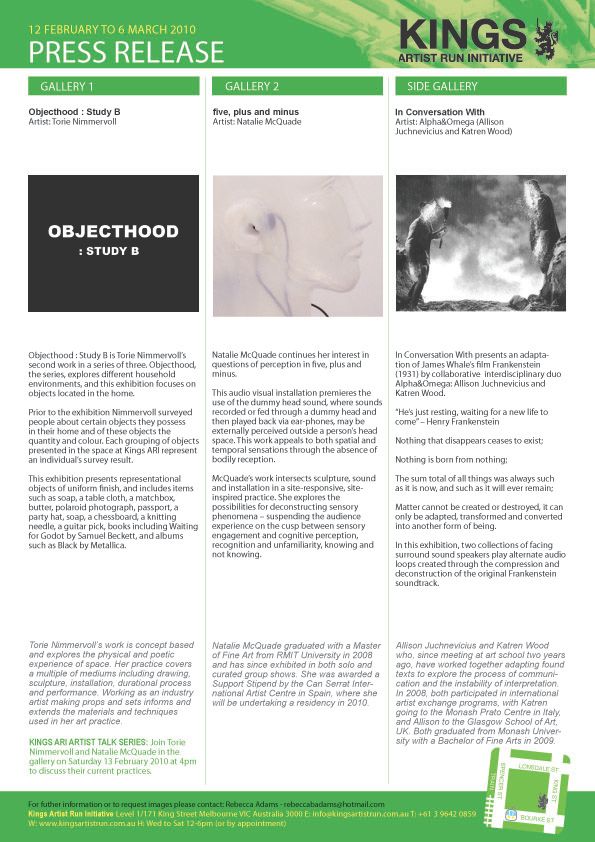
Here is an image of our work In Conversation With,
a sound installation exhibited at Kings ARI from 12th February - 6th March 2010.
Some of our promotional images....
In Conversation With …
There is a popular (and wilful) misconception that the name Frankenstein applies to the hulking monster forever animated in our memory by Boris Karloff. This name seems to suit the strangely pitiable giant and has entered our vernacular to describe a protégé that has broken the bounds of control. But the name should refer, as we all know, to his reckless creator, Victor Frankenstein. For Mary Shelley’s original novel is about creation.
There is, in fact, a chain of authorial creation that can be traced in relation to this story, over and above its central theme. Based on the Promethean legend from Greek mythology, the original novel takes aim at a number of targets – the impending industrial revolution and parental responsibility towards one’s offspring foremost amongst them. But the story continues to evolve just like the monster itself. James Whale’s definitive film version (1931) adds several more layers, most interestingly in this context the character of Fritz – Dr. Frankenstein’s assistant. Rather than the comparatively straightforward re-animation of corpses, Whales’ Victor Frankenstein aims to assemble a being made from many parts, hence the importance of his evil assistant. For it is Fritz who brings him a criminal’s brain – the item that will complete the collection of body parts his master has sewn together. With the aid of electricity the composite creation can now be brought to life.
In this way James Whale presents Victor Frankenstein as an artist, a montagist whose mission is to stretch the bounds of possibility. Rather than the naïve and ultimately irresponsible chemistry student from the novel, the monster’s creator is now “Dr.” Frankenstein – the template, in the eyes of many, for the mad scientist. And so the Frankenstein story, like the monster, develops beyond the creative intention of its original author and becomes, in short, its own monster. Similarly, the mad scientist becomes akin (in ambition rather than moral purpose) to the artist.
Alpha and Omega (aka Allison Juchnevicius and Katren Wood) have obliquely joined this chain of creation and offer us a portrait of the creative loop. Key fragments of dialogue from Whales’ film now echo endlessly back at us, as though the voices were ricocheting around an alpine canyon in the vicinity of Castle Frankenstein. With the aid of (filmic) body parts and electricity the creature is once more brought to life – ghostly as this re-presentation may be.
Juchnevicius and Wood, like Victor Frankenstein, have a history of creative activity based on the reassimilation and re-presentation of found and orphaned fragments - texts, images and sounds. Their collaboration is, of course, non-hierarchical and springs from fluid exchange and overlap. Their ideas are pooled and stitched together, then “released” as new entities. Clearly there is no danger of these creative hybrids turning on those who made them but, just as clearly, they now have a life of their own.
The art of collage has evolved far beyond the early experiments of Picasso and Schwitters and should be understood as a way of thinking rather than a method or technique. In the Alpha and Omega laboratory Juchnevicius and Wood (no doubt clad in white coats) preside over an operating table strewn with fragments and ideas. With both patience and clarity of intention they slowly assemble new possibilities of perception from the dismembered familiarity they collect.
Dr. Michael Vale
February 2010
Monash University
More information can be found on the KINGS ARI website HERE